World
United States Denies Visas to Palestinian Officials Ahead of UN General Assembly for Second Year
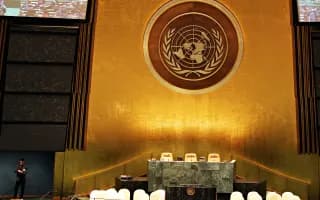
The US state department has again denied entry visas to Palestinian officials ahead of next week's United Nations general assembly in New York, barring the Palestinian delegation from attending in person for the second consecutive year. In a statement, the department said the Palestinian Authority and the Palestine Liberation Organization had failed to live up to their commitments, accusing them of working to internationalize the Israeli-Palestinian conflict through the international courts and of glorifying terrorism. The Palestinian foreign ministry rejected the allegations as an unjustified measure that undermines peace efforts. Among those barred is Palestinian president Mahmoud Abbas, whom the general assembly voted on Thursday to allow to address the gathering by video when the general debate begins on 22 September.

World
Aoun Joins Macron and Jordan's King in Paris to Plan Lebanon's Post-UNIFIL Security
Lebanese President Joseph Aoun held talks with French President Emmanuel Macron and Jordan's King Abdullah II at Les Invalides in Paris on Thursday, ahead of a preparatory session for an international conference backing Lebanon's army and security forces as the UN peacekeeping mandate in southern Lebanon approaches its expiry. The three leaders reviewed a new round of the Aqaba Process meetings focused on strengthening the Lebanese Armed Forces and Internal Security Forces, discussed regional de-escalation, and addressed developments in Gaza, the occupied West Bank and occupied East Jerusalem. In a separate meeting at the Elysee Palace, Aoun and Macron discussed efforts to end Israeli attacks on Lebanon within a US-sponsored framework providing for phased Israeli withdrawal in exchange for Lebanese army deployment. Israeli attacks since March 2 have killed at least 4,381 people, injured 12,402 and displaced more than 1 million, according to Lebanese authorities, and UNIFIL's mandate expires at the end of the year, with France and Italy having proposed a European force to assist the Lebanese army along the border.
World
UN Finds Grounds to Believe US Committed War Crimes in Iran School Strike That Killed 120 Children
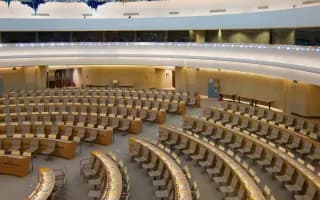
A UN fact-finding mission has determined there are reasonable grounds to believe the United States committed war crimes when it struck an Iranian primary school and a sports complex in February, killing 156 civilians including 120 children. The independent mission, reporting to the UN Human Rights Council in Geneva, found the Tomahawk strike on Shajareh Tayyebeh school in Minab was indiscriminate and reckless, with failed intelligence verification amounting to more than negligence. The report also accuses Iranian authorities of crimes against humanity in a protest crackdown that officially left 3,038 dead, as the Pentagon's own inquiry remains unpublished months after it concluded.

World
Houthis Seize Strategic Red Sea Islands as Fears Grow Over Global Oil Supply Disruption
Yemen's Houthi militants have seized the strategic islands of Greater and Lesser Hanish in the Red Sea, reinforcing their control over the Bab al-Mandab strait chokepoint as warnings mount of a new global oil supply crisis. The capture follows the group's seizure of the port of Mokha and Perim island in a swift advance along Yemen's Red Sea coast that has displaced nearly 94,000 people, according to the International Organization for Migration. The development compounds pressure on Saudi Arabia, whose vital east-west oil pipeline has been shut by drone attacks blamed on an Iran-allied militia in Iraq, with officials estimating weeks of repairs. Market analysts warn that any prolonged disruption could push oil prices sharply higher after Brent crude rose to $106.92 a barrel.

World
AWS Confirms Saudi Cloud Region Launch for December 2026 With 50 Megawatts for HUMAIN AI Zone
Amazon Web Services confirmed at the LEAP technology conference in Riyadh that its first cloud infrastructure region in Saudi Arabia remains on track to launch in December 2026, backed by a planned investment of more than 5.3 billion dollars, and disclosed a new commitment to make up to 50 megawatts of AI computing capacity available through a partnership with HUMAIN by 2028. The announcement deepens the relationship between the world's largest cloud provider and the Public Investment Fund-owned AI company launched by Crown Prince Mohammed bin Salman in May 2025. The Saudi region will extend AWS's global footprint to 40 regions, while the AI Zone will deploy up to 150,000 AI accelerators including NVIDIA GB300 systems and AWS Trainium chips. AWS chief executive Matt Garman and Saudi Communications Minister Abdullah Alswaha both framed the buildout as central to Vision 2030.

World
US Launches Fresh Strikes on Iran as State Media Reports Four Killed at Wedding
The United States launched fresh military strikes on Iran on September 1, 2026, with state media reporting that four people were killed at a wedding party. The strikes targeted military facilities in central Iran according to US Central Command. Iranian state media reported civilian casualties including women and children. The strikes represent an escalation in the ongoing conflict between the two nations. The International Committee of the Red Cross called for protection of civilians amid the escalating hostilities. The conflict has raised fears of a wider regional war that could disrupt global energy supplies and destabilize the Middle East. Oil prices surged following the announcement with benchmark Brent crude rising more than 5 percent in early trading on global commodity exchanges.

World
Saudi Arabia Plans 11 New Stadiums for 2034 World Cup After Winter Hosting Concerns
FIFA confirmed Saudi Arabia as host of the 2034 World Cup on Dec. 11, 2024, making the kingdom the second Middle Eastern nation to stage the tournament after Qatar in 2022. The Saudi bid pledges to build 11 new stadiums, but FIFA's own evaluation report flags an elevated scheduling risk because summer temperatures exceed 100 degrees Fahrenheit and Ramadan falls between Nov. 11 and Dec. 10 that year. The Norwegian Football Federation abstained from the confirmation vote in protest at a bidding process that produced no rival candidate, while Asian federations rallied behind the kingdom after FIFA president Gianni Infantino called on the confederation to unite behind a single bid.

World
Iran and Saudi Arabia Agree to Joint Maritime Security Patrol in Strait of Hormuz
Iran and Saudi Arabia signed a maritime security cooperation agreement on September 2, 2026, establishing joint naval patrols in the Strait of Hormuz through which 21 million barrels of oil transit daily. The agreement was brokered by Oman and Qatar during six months of secret negotiations in Muscat. Iranian Foreign Minister Abbas Araghchi stated that the deal represents a fundamental shift in regional security architecture. Saudi Energy Minister Prince Abdulaziz bin Salman confirmed that joint patrols will begin by October 2026 with a combined fleet of 12 vessels. The International Energy Agency estimated that improved security in the strait could reduce oil price volatility by 15 to 20 percent.

World
UAE and Saudi Arabia Sign Landmark Water Desalination Deal Worth $8.4 Billion
The United Arab Emirates and Saudi Arabia signed an $8.4 billion joint venture agreement on August 30 to build the world largest solar-powered water desalination complex on the Red Sea coast. The facility, expected to be operational by 2029, will produce 1.5 million cubic meters of fresh water daily using reverse osmosis technology powered entirely by a 4.2 gigawatt solar array. The deal marks the largest single investment in desalination infrastructure in Middle East history and addresses acute water scarcity affecting over 60 million people across the Gulf region.