Progress 96 Carries Nearly Three Tons of Supplies to Space Station as NASA Slips Crew-13 to October
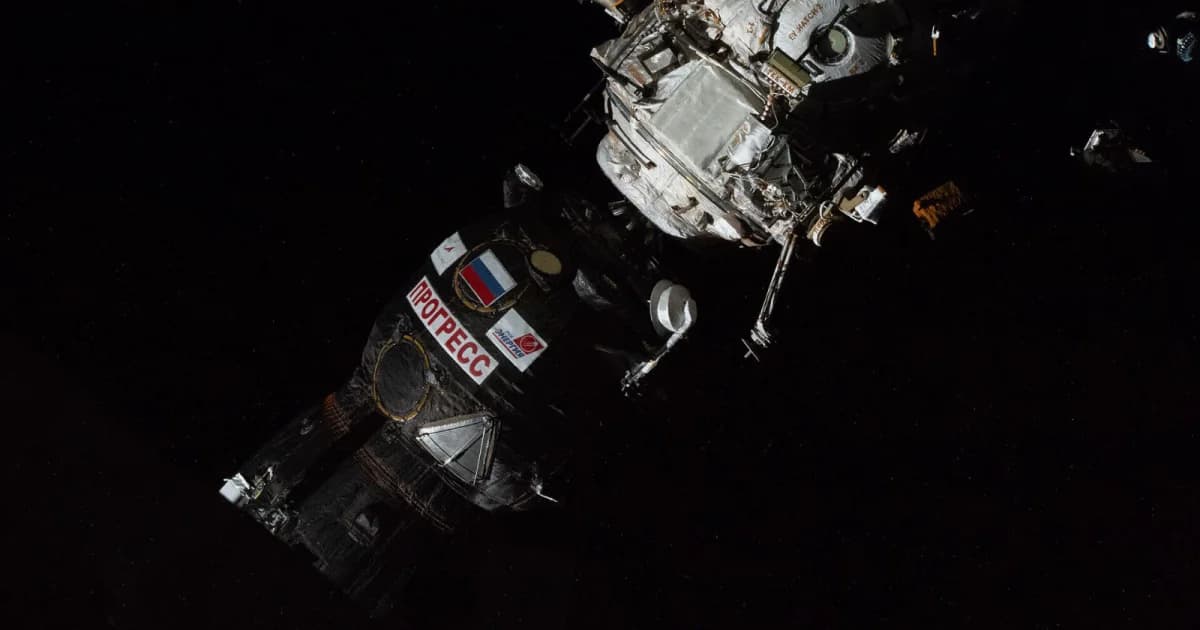
New supplies are on their way to the International Space Station after launching aboard a Progress 96 cargo spacecraft at 9:33 a.m. EDT on Wednesday.
Progress 96 will arrive Saturday for an automated docking to the Poisk module at 9:46 a.m. EDT, bringing nearly three tons of food, fuel, and cargo to the Expedition 75 crew members aboard the orbiting laboratory.
## Crew-13 Slips to October
NASA and SpaceX are now targeting as soon as early October for the launch of the Crew-13 mission, allowing for completion of prelaunch activities, readiness reviews, and coordination of space station operations.
The schedule change followed a hardware fix: the team successfully replaced an oxidizer valve in Dragon's propulsion system after a leak was detected earlier in processing.
The Crew-12 members — Andrey Fedyaev of Roscosmos, Jack Hathaway and Jessica Meir of NASA, and Sophie Adenot of ESA — have been aboard since February 14 and spoke to journalists on the ground during a news conference Wednesday.
## Research in Microgravity
While awaiting the new arrivals, the seven residents stayed focused on ongoing microgravity research, cargo operations, and lab maintenance throughout Wednesday.
Station commander Jessica Meir of NASA documented her sleep quality, collected a saliva sample, and downloaded biomedical data from her smart watch for the RelaxPro investigation, which aims to help reduce stress and improve sleep for astronauts. She also transferred cargo in and out of Northrop Grumman's Cygnus XL spacecraft, berthed to the Unity module's Earth-facing port since April 14.
NASA flight engineer Anil Menon soldered components on a circuit board in the Harmony module using lead-free soldering techniques, demonstrating the safe manufacturing and repair of electronics in microgravity. The space-soldered samples will return to Earth for comparison against identical ground-soldered samples, with results that could reduce reliance on costly resupply missions.
Flight engineer Jack Hathaway installed new water filter cartridges in the Destiny laboratory's oxygen generation system, removing fluoride ions to keep water pure as it passes through the spacecraft's systems. ESA flight engineer Sophie Adenot worked out on the new European Enhanced Exploration Exercise Device installed in the Columbus module, its controller software tracking her performance to help researchers evaluate the device for future long-duration missions.
## Cosmonauts Keep Zvezda Running
The three Roscosmos cosmonauts, flight engineers Pyotr Dubrov, Anna Kikina, and Andrey Fedyaev, spent their shift on station maintenance. Dubrov tested power systems and cleaned vents in the Zvezda service module, while Kikina serviced Zvezda's Elektron oxygen generator and cleaned fan screens in the Rassvet module. Fedyaev inspected and photographed laptop computers and their power supplies.
Meir also reflected on her recent spacewalk, when she rode the Canadarm2 robotic arm during operations outside the orbiting laboratory. "I felt like I was just there levitating above the Earth. I think that was the biggest eureka moment for me," she said.
The station's busy week continues Saturday with Progress 96's arrival, ahead of a Crew-13 launch that will rotate four new residents into the Expedition 75 crew and return Meir, Hathaway, Adenot and Fedyaev to Earth after more than seven months in orbit.
## A Window Into Station Operations
The dual updates illustrate the logistical rhythm of the space station, where crewed rotation and robotic resupply interlock weeks in advance. Progress freighters fly on a regular cadence from the Baikonur Cosmodrome, and each arrival brings the food, water, propellant and spare parts that keep the outpost continuously staffed. Saturday docking at Poisk, the Russian segment docking module, will add to the ships already berthed at the complex, including the Cygnus XL that has been part of operations since April.
The Dragon valve replacement likewise shows the value of the processing delay rather than a rushed schedule. Propulsion oxidizer systems are flight-critical on crewed spacecraft, and teams routinely work such issues during the weeks between vehicle rollout and launch. The retarget from late September to early October preserves the standard review chain: prelaunch activities, readiness reviews and coordination of space station operations, each requiring formal sign-off before a crewed flight proceeds.
For the research community, the passage also matters. Experiments now aboard — from RelaxPro sleep monitoring to the space-soldering demonstrations that could reshape how astronauts repair electronics far from Earth — ride on continuous staffing. A smooth Progress 96 docking Saturday keeps those investigations stocked and on schedule, while Crew-13 will bring a fresh complement of scientists-in-orbit to hand off the ongoing work.
Station operations continue around the clock in the meantime, with the Expedition 75 crew balancing science payloads, maintenance circuits and exercise protocols as the outpost circles the planet every 90 minutes.
## What Comes Next on the Calendar
Saturday at 9:46 a.m. EDT marks the next milestone, when Progress 96 performs its automated docking to Poisk without crew intervention, a routine that Russian cargo vehicles have executed for decades. The nearly three tons of cargo will then be unpacked across the following weeks, replenishing consumables that the Expedition 75 crew and the incoming Crew-13 rotation will draw on through the autumn.
Early October remains the planning target for Crew-13, subject to the completion of Dragon processing and the station operational reviews NASA coordinates with international partners. The early-October window also accounts for Progress 96 operations and any continued analysis of the propulsion system following the oxidizer valve replacement, ensuring the two traffic streams do not conflict on approach or departure corridors.
The coordination underscores how tightly packed the station schedule has become, with commercial crew rotation, Russian Progress cargo, Northrop Grumman Cygnus berthing and occasional visiting vehicles all sharing the same orbital operating picture. Each arrival or departure shifts power, attitude and communications planning across the complex, executed by flight controllers in Houston, Moscow and payload centers worldwide.
Discussion
Recommended for you
More science
Space
NASA's Roman Space Telescope Wakes Up in Space as Fuel Findings Point to Doubled Mission Life
9/16/2026
Space
NASA's Roman Space Telescope Launches on Falcon Heavy to Seek Dark Universe
9/16/2026
Space
Scientists Discover Hidden Immune Organ Inside the Skull Bone Challenging Assumptions
9/2/2026
Space