NASA's Roman Space Telescope Wakes Up in Space as Fuel Findings Point to Doubled Mission Life
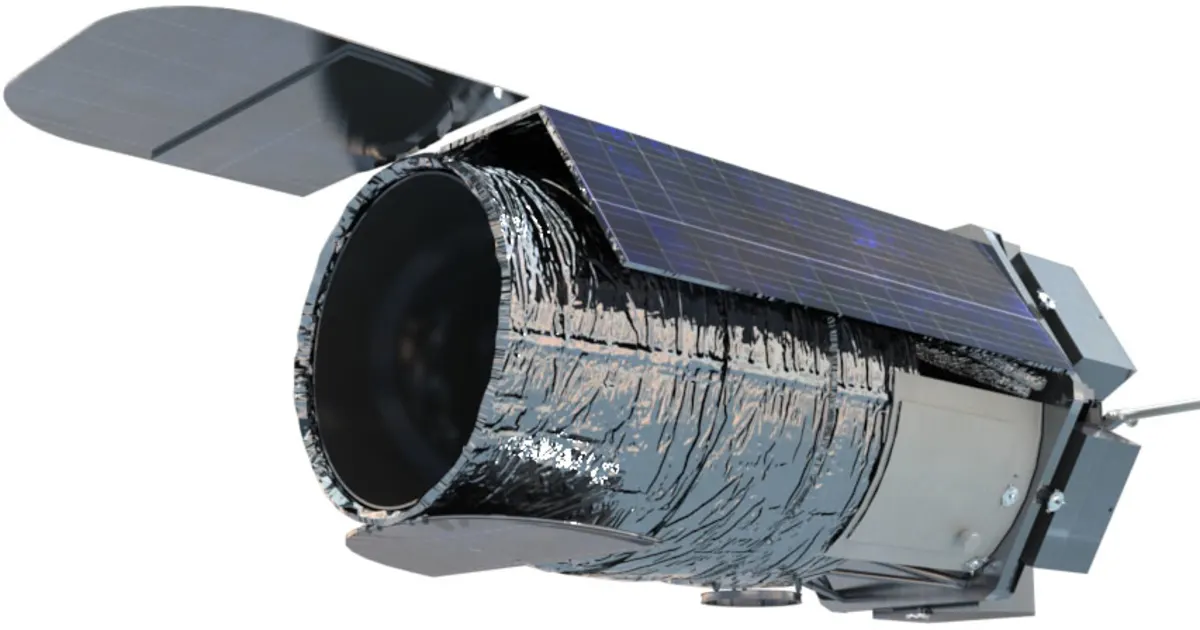
NASA has begun flipping on the instruments aboard the Nancy Grace Roman Space Telescope to prepare the observatory for its scientific mission as it travels nearly a million miles to its final destination in orbit.
The power-on milestone comes with new analysis indicating that the telescope's fuel could sustain operations for roughly 22 years, about double NASA's expectations, after the performance of the rocket that carried the observatory to space proved so accurate that fewer trajectory adjustments will be needed than planned.
Roman launched atop a SpaceX Falcon Heavy rocket from the Kennedy Space Center on August 30 on a $4.3 billion mission to probe dark energy, dark matter and exoplanets. It is bound for the second sun-Earth Lagrange point, 750,000 miles beyond the moon, where the James Webb Space Telescope also operates.
Roman was "exactly where it needed to be," said Denton Gibson, launch director of NASA's Launch Services Program. "That's a monumental effort because we know the more accurate the launch vehicle is, the more science we can get."
## A Telescope Built for Speed
The 42-foot-long, 18,000-pound observatory carries a 300-megapixel wide-field camera that captures wide-angle, ultra-sharp images, a field of view so large that a single full-resolution frame would cover 45 city blocks.
Roman will scan broad swaths of the cosmos roughly 1,000 times faster than the Hubble Space Telescope, collecting as much data in one month as Hubble managed in a century. Where Hubble beamed back about 172 terabytes of data over 30 years, Roman will downlink a staggering 2,500 terabytes over its five-year primary mission.
"Roman will give the Earth a new atlas of the universe," said NASA Administrator Jared Isaacman. NASA science chief Niki Fox described the telescope as "a sheer powerhouse" and "literally a speed machine."
"The speed at which we'll be scanning the sky, delivering vast amounts of data and returning results will be at an unprecedented rate, never done before," Fox said.
## What Happens Before First Light
Commissioning the spacecraft will take three to four months, calibrating its instruments and testing its subsystems before science operations begin in earnest. The observatory should beam back its first images before the winter holidays, said Jackie Townsend, Roman's project manager, with the first year of science observations slated to begin in January 2027.
The telescope's two instruments are the wide-field infrared camera, offering panoramic views 100 times wider than Hubble's, and an advanced coronagraph with deformable mirrors that block a star's glare to reveal the vastly dimmer light of orbiting planets. The coronagraph is expected to detect Jupiter-size worlds and could capture planets about 100 million times fainter than their stars, said Vanessa Bailey, the coronagraph instrument scientist at the Jet Propulsion Laboratory.
"A launch is such a transition point," said Julie McEnery, Roman's senior project scientist at NASA's Goddard Space Flight Center. "It's a transition because it's an end point for the engineers, but it's a starting point for the scientists."
## Surveys That Will Redefine the Sky Map
Three core surveys anchor the primary mission. The High-Latitude Wide-Area Survey will cover 12% of the entire sky over 520 days, cataloging the distribution of a billion or more galaxies. The High-Latitude Time-Domain Survey will repeatedly image a region of 90 full moons to capture transient events from supernova blasts to stars falling into black holes. The Galactic Bulge survey will watch hundreds of millions of stars for microlensing signals, expected to yield tens of thousands of new exoplanets.
More than 6,200 exoplanets have been discovered to date using instruments like NASA's Kepler telescope, and Roman is expected to add more than 100,000 more over just 18 months of observations.
Fox summarized the expected haul: "Billions of galaxies will be found, tens of billions of new stars, tens of thousands of new planets, and thousands of supernovae, all wrapped up in one beautiful telescope."
With the instruments now waking up and fuel reserves pointing toward decades of possible operations rather than years, the most expensive expectations riding on Roman concern what it cannot plan for. "I very much hope, and in fact expect, that the most exciting science from Roman will be a surprise, something we couldn't predict," McEnery said.
The findings are also expected to bear on the so-called Hubble Tension, the mismatch between expansion rates measured from the early cosmos and nearby supernovae that suggests a critical element may be missing from the standard model of cosmology.
Roman's survey data will overlap with the panoramic sky maps being assembled by the Vera C. Rubin Observatory in Chile and the European Space Agency's Euclid telescope, a trio whose combined measurements are expected to sharpen understanding of dark energy and dark matter.
With first images due before the holidays, the doubled fuel outlook is the clearest sign yet that the observatory built around a donated spy-satellite mirror may outlast its own most optimistic plans.
Discussion
Recommended for you
More science
Space
NASA's Roman Space Telescope Launches on Falcon Heavy to Seek Dark Universe
9/16/2026
Space
Scientists Discover Hidden Immune Organ Inside the Skull Bone Challenging Assumptions
9/2/2026
Space
SpaceX and NASA Complete Mars Sample Return Mission Preparation as Launch Window Approaches
9/2/2026
Space