NASA Targets October for SpaceX's 35th Cargo Launch With Final Solar Arrays
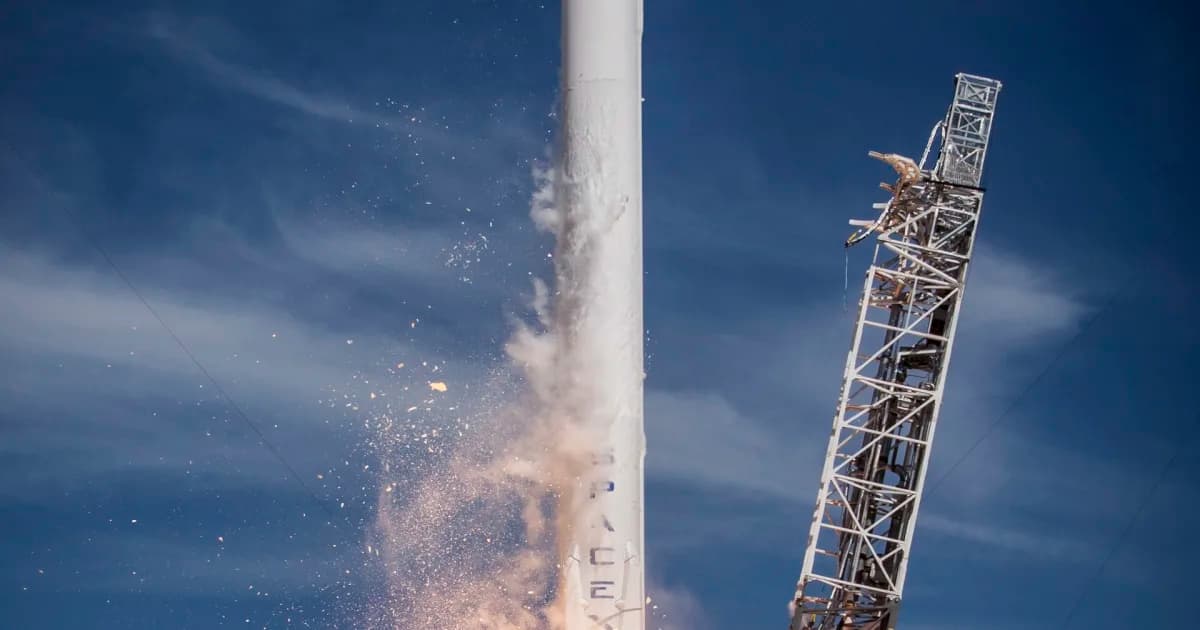
NASA and SpaceX are targeting no earlier than October to launch the 35th SpaceX commercial resupply services mission to the International Space Station, with media accreditation for the launch opening Thursday.
The SpaceX Dragon spacecraft will lift off on a Falcon 9 rocket from Cape Canaveral Space Force Station in Florida, delivering NASA science investigations, supplies and equipment to the orbital laboratory. The credentialing deadline for US media is 11:59 p.m. EDT on Thursday, October 1, with applications submitted through NASA Kennedy Space Center's accreditation website. Media will receive a confirmation email upon approval, and questions about accreditation or special logistical support go through the Kennedy newsroom.
Each resupply mission to the station delivers scientific investigations in biology and biotechnology, Earth and space science, physical sciences, and technology development and demonstrations. NASA describes cargo resupply from US companies as ensuring a national capability to deliver scientific research to the space station, significantly increasing the agency's ability to conduct new investigations aboard the orbital outpost.
## Completing the Station's Power Upgrade
In addition to food, supplies and equipment for the crew, Dragon will deliver the final sets of International Space Station Roll-Out Solar Arrays, known as IROSA, which astronauts will install during future spacewalks to complete the station's power augmentation.
Once installed, the arrays will provide additional power to support critical station operations — including its safe and controlled deorbit, the engineered end-of-life pathway for a laboratory that has been continuously crewed for more than 25 years. The final IROSA delivery marks the closing chapter of a power upgrade campaign designed to keep the aging station operating through its remaining years.
The rollout array design matters for that timeline: unlike traditional rigid panels, IROSA arrays unfurl from compact rolls — an approach that allowed them to be delivered in pieces sized for cargo trunks and installed incrementally across multiple missions without requiring an dedicated shuttle of their own. Their additional output supplements the station's original eight solar array wings, which have degraded after more than two decades of continuous service in orbit, restoring margin that station managers say is required both for expanded commercial research activity and, ultimately, for the controlled reentry that will end the station's service.
## Science Bound for Orbit
The mission will transport several new experiments to the orbital complex, including hardware to manufacture artificial retinas in microgravity that could help restore vision for patients on Earth and 3D heart cell models to advance large-scale drug testing on future space missions.
Dragon also will carry materials to study how a new type of glass is formed in microgravity, and brain organoids that could uncover potential treatment targets for neurodegenerative diseases like Alzheimer's, Parkinson's and multiple sclerosis.
The microgravity environment is central to each investigation: retinal implants manufactured in orbit can achieve structures difficult to produce under Earth's gravity, heart cell models grown in space mature in ways that improve drug-screening reliability, and novel glass formation without gravity-driven convection offers material properties unattainable in terrestrial furnaces.
## A Resupply Record Entering Its 35th Flight
The flight continues a partnership that has made commercial cargo routine. The previous Dragon cargo mission, the 34nd commercial resupply flight, launched on May 15, 2026, carrying about 6,500 pounds of science, supplies and equipment to the station.
For more than 25 years, people have lived and worked continuously aboard the International Space Station, advancing scientific knowledge and making research breakthroughs not possible on Earth. NASA frames the station as helping the agency understand and overcome the challenges of human spaceflight, expand commercial opportunities in low Earth orbit, and build the foundation for long-duration missions to the Moon under the Artemis program and eventually Mars.
The October launch window also positions CRS-35 as one of the final building blocks of the station's current configuration: with the last IROSA arrays aboard and installed, the orbital laboratory's power system will be complete, its research racks full, and its deorbit plan increasingly a matter of scheduled engineering rather than distant contingency. Mission managers are expected to confirm the precise launch date as the Dragon spacecraft and Falcon 9 first stage complete processing at the Florida spaceport, with prelaunch and launch coverage plans to be announced once the target firms up.
The science manifest illustrates how station research has shifted from demonstration to development. Artificial retina manufacturing in orbit is a commercial production question, not a laboratory curiosity; heart cell models in microgravity feed directly into pharmaceutical screening pipelines; and the brain organoid studies arrive as terrestrial neurodegenerative research continues to struggle with models that replicate human disease progression. Each payload category NASA listed connects to a private-sector or clinical end user on the ground, a maturation that agency officials frequently cite when defending the station's operating budget against schedule pressure from commercial station successors now in development.
Discussion
Recommended for you
More science
Space
Progress 96 Carries Nearly Three Tons of Supplies to Space Station as NASA Slips Crew-13 to October
9/17/2026
Space
NASA's Roman Space Telescope Wakes Up in Space as Fuel Findings Point to Doubled Mission Life
9/16/2026
Space
NASA's Roman Space Telescope Launches on Falcon Heavy to Seek Dark Universe
9/16/2026
Space