Ethiopia Plants Toward 50 Billion Trees as Citizens Lead a Green Revival Against Deforestation
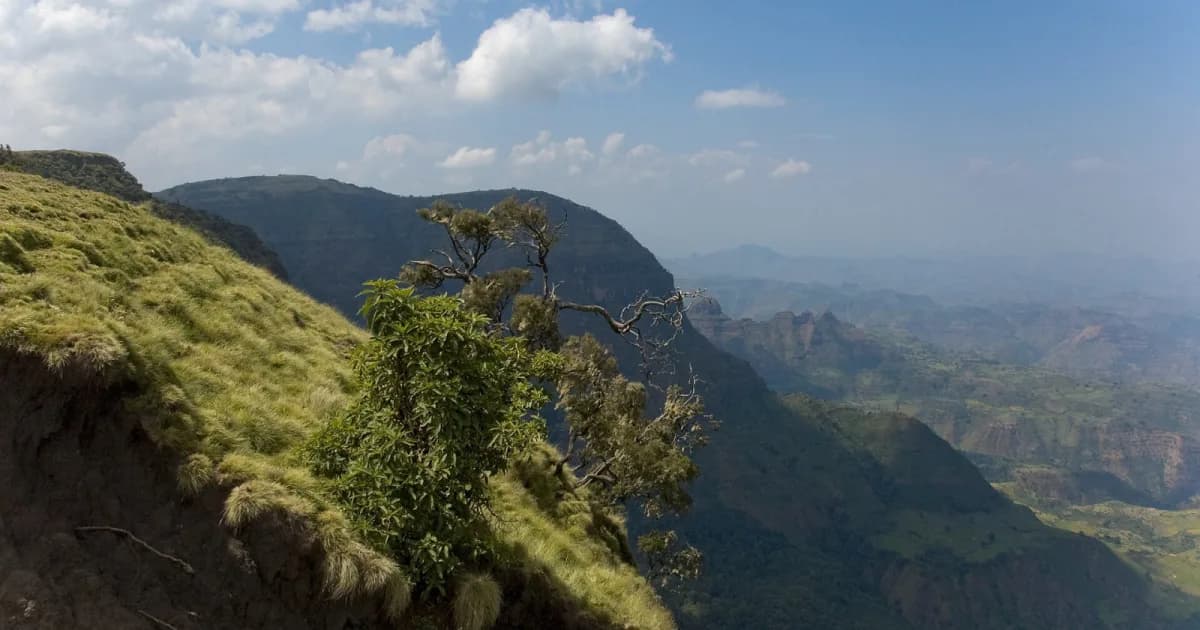
When Halima Kedir first began planting trees in Ethiopia's Oromia region, her neighbours mocked the effort. Today her garden is lush with banana, olive and grevillea trees, and the people who doubted her are following her lead.
"They thought I was striving for nothing, but with time, many are realising that trees can be part of the solution to our problems as a way to fight climate change and food insecurity," she says.
## A Nation Reversing Centuries of Loss
Kedir, 35, who lives in the Berbere district, became an accidental environmentalist after planting thousands of trees, inspiring others to follow suit. "Now, everything has changed. Those who tried to dissuade me are envious of my effort and commitment," she says.
Her work sits within a national turnaround. From the turn of the century to 2025, Ethiopia lost 560,000 hectares of tree cover to agricultural expansion, commercial logging and charcoal use, damaging biodiversity, soil quality and water resources.
But between 2013 and 2023, the annual deforestation rate fell from 92,000 hectares to 27,703 hectares, while forest cover increased from 15.5 percent to 23.6 percent, according to government figures — a reversal that predates the current campaign but has accelerated under it.
Through the Green Legacy Initiative launched in 2019, the government claims to have planted 48 billion trees in seven years, including a reported record-breaking 353 million seedlings in a single day. Its goal is 50 billion trees by 2030. The programme has made tree planting a civic ritual in schools, government offices and neighbourhoods across the country, seeding a generation that has grown up with planting campaigns as part of public life.
## Citizens Carry the Campaign
Kedir's neighbour, Fate Abdulahi, joined after seeing what she achieved. "She proved us wrong and she has become a role model and someone willing to find local solutions to our issues," Abdulahi says.
Thousands of households in nearby kebeles have joined the initiative, and with help from WaterAid Ethiopia, once-degraded land is transforming into greener terrain. Alebachew Adem, director of WaterAid Ethiopia, says approximately 55,000 indigenous tree seedlings have been distributed across the area, with 85 percent growing successfully.
"In dry land and climate-vulnerable areas such as Berbere, these efforts help communities build resilience against the increasing impacts of climate change," he says.
Despite severe water shortages, Kedir walks about an hour to fetch water for her seedlings, which she describes in maternal terms. "Just like we adopt a child in our tradition, I see them like my own children," she says. Her 13-year-old son, Anwar Hassen, hopes to follow her: "I want to make a lifelong commitment in the fight against climate change."
Many in the community link her success to guddifachaa, the traditional Oromo practice of adopting a child and integrating them into society. Her example has spread because it costs little and demands only persistence: a spade, seedlings, and water carried on foot in a district where both water and hope were once scarce. What began as one woman's improvisation has become a template that development workers now cite to other climate-vulnerable districts across the east African nation.
## Survival, Not Planting, Decides Success
Survival rates remain the central question. The government-backed GLI technical committee reported average seedling survival of 83.4 percent in 2019 and 79 percent a year later, figures met with some scepticism. In research conducted in Asia, nearly half of reforestation trees did not survive five years, and researchers examining 15 tree-planting schemes in Ethiopia found 10 had achieved less than 50 percent success.
Yitebitu Moges, co-ordinator of the REDD+ deforestation scheme at the UN Environment Programme in Ethiopia, says the greatest success has been in the highlands and a survival study is under way. "We are collecting data and are now committing ourselves to a systematic assessment of survival rates," he says.
"Our history has shifted from deforestation to forestation," he adds. "Even if half of the trees that have been planted survive, we are already gaining moisture, keeping soil and sequestering carbon."
Two years ago Ethiopia's parliament created the Green Legacy and Landscape Restoration Special Fund, allocating between 0.5 and 1 percent of its 2.339 trillion birr annual federal budget — roughly 50 to 110 million pounds — to restoring degraded landscapes.
Teshome Soromessa, an environmentalist at Addis Ababa University, says Kedir's commitment shows how individual citizens become catalysts for restoration. He argues the initiative has aligned households, civil society organisations, universities and government institutions around a single national priority, something few environmental programmes achieve at scale.
Ethiopia, a nation of more than 130 million people, has been chosen to stage COP32 in Addis Ababa in November 2027, a forum where its planting claims will face international review. Kedir has a message for the delegates: "They should give the issues of water and trees, which many in such communities lack, the priority they deserve."
Discussion
Recommended for you
More world
Africa
Jihadist Violence in Africa's Sahel Set to Hit Record Levels Twenty-Five Years After 9/11
9/16/2026
Africa
Dangote Refinery IPO Opens in Nigeria Seeking 2.15 Trillion Naira From African Investors
9/15/2026
Africa
Google Announces Major AI Research Center Expansion Across Africa
9/2/2026
Africa